

- Home
- /
- Results of Financial Activity
Results of Financial Activity
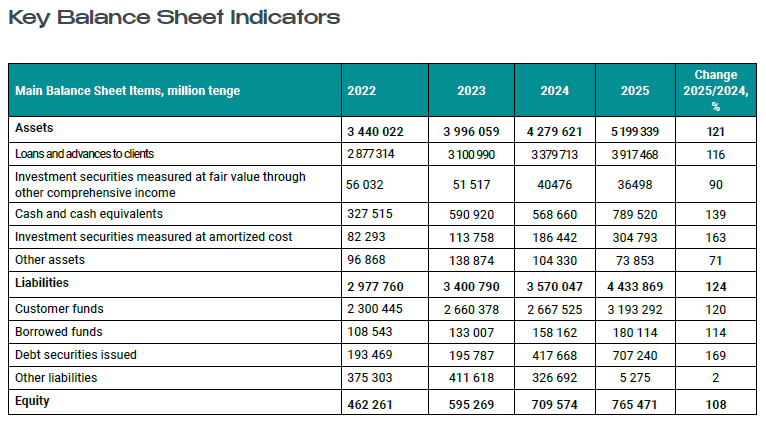
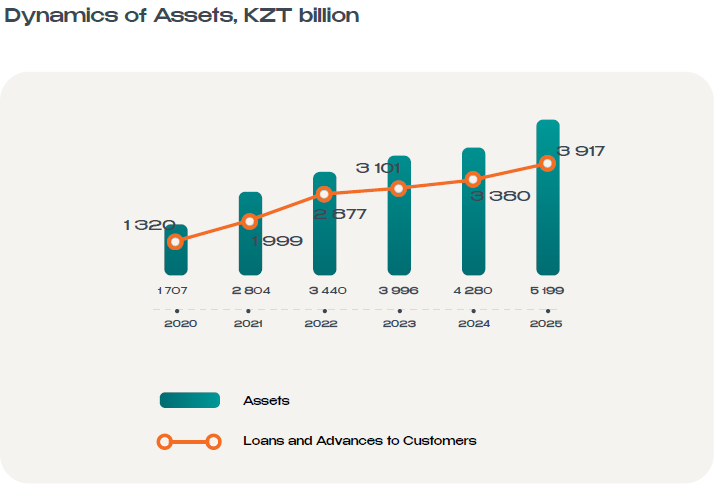
The Bank's assets in 2025 grew by 21.5% or by 919.7 billion tenge and amounted to 5.2 trillion tenge.
As of the end of 2025, the share of non-performing loans with a delinquency over 90 days (NPL 90+) in the Bank stood at 0.12%, which corresponds to the lowest value in the banking sector of Kazakhstan.
The Bank's investments in securities account for 7% of assets based on the 2025 results. The share of cash and cash equivalents is 15%. Investment activity is aimed at the effective management of available free cash funds in order to preserve the Bank's assets.
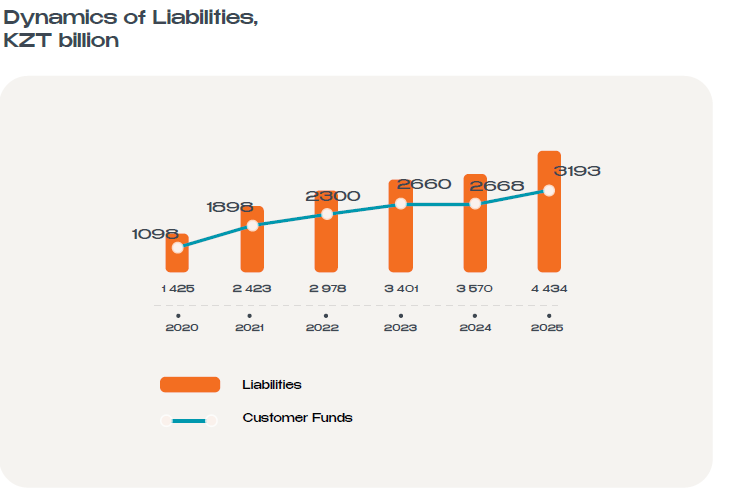
The Bank's liabilities at the end of 2025 grew by 24.2% or by 863.8 billion tenge and amounted to 4.4 trillion tenge. Customer funds account for 72% of the structure of liabilities. The volume of customer accounts at the end of the year amounted to 3,193 billion tenge.
The Bank's activity is characterized by a low level of debt burden. Borrowed funds at the end of 2025 amounted to 4% of liabilities, and the share of issued securities was 16%.
The volume of borrowed funds in 2025 grew by 22 billion tenge or by 14%, primarily due to the provision of financing within the framework of state development programs.
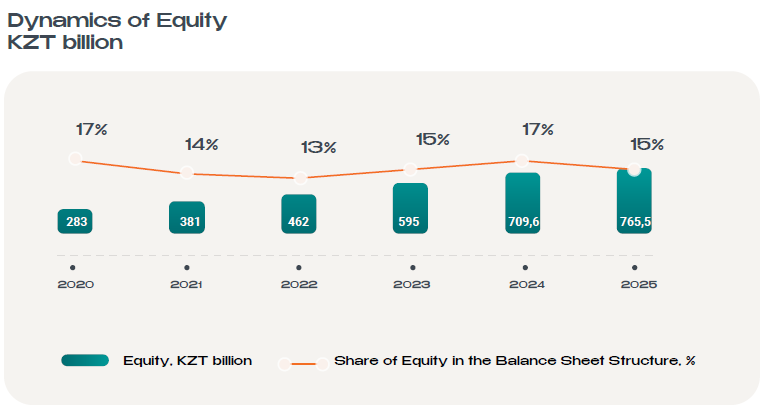
The Bank's equity in 2025 increased by 8% and reached 765.5 billion tenge. The share of equity in the structure of the Bank's balance sheet is 15%, which indicates high financial stability and independence of the Bank's financial position.
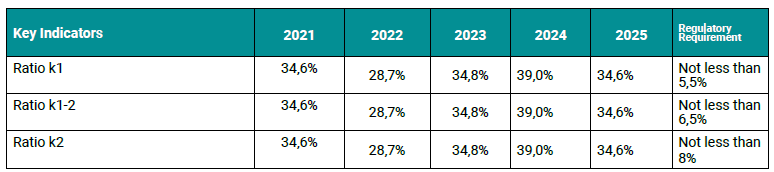
The Bank continues to maintain a high level of liquidity and capital adequacy, significantly exceeding the requirements of the regulator, which was the result of high-quality work on asset management. The prudential capital adequacy ratios k1, k1-2, and k2 in 2025 developed at the level of 34.6%, exceeding the regulatory values by more than four times.
The Bank's profit for 2025 grew and amounted to 126.4 billion tenge. The Bank maintains sufficient profitability indicators. The ROE indicator in 2025 was 17.1%, and ROA was 2.7%.
Plan-vs-Fact Analysis
Comparison of Planned and Actual Values of Main Indicators
|
Indicator Name |
Unit |
Actual 2022 |
Actual 2023 |
Actual 2024 |
Plan 2025 |
Actual 2025 |
Execution, % |
|
Assets |
million tenge |
3 440 105 |
3 996 059 |
4 279 621 |
4 937 318 |
5 199 339 |
105 |
|
Equity |
million tenge |
462 261 |
595 269 |
709 574 |
800 655 |
765 471 |
96 |
|
Liabilities |
million tenge |
2 997 843 |
3 400 790 |
3 570 047 |
4 136 663 |
4 433 869 |
107 |
|
Income |
million tenge |
281 470 |
359 182 |
369 177 |
420 774 |
449 869 |
107 |
|
Expenses |
million tenge |
185 435 |
211 654 |
248 384 |
300 700 |
323 435 |
107 |
|
Net profit |
million tenge |
96 035 |
147 528 |
120 793 |
120 075 |
126 434 |
105 |
|
ROE |
% |
22,77 |
27,90 |
18,51 |
15,90 |
17,14 |
108 |
|
ROA |
% |
3,08 |
3,97 |
2,92 |
2,61 |
2,67 |
102 |
|
Deposit base |
million tenge |
2 140 681 |
2 362 586 |
2 421 456
|
2 548 403
|
2 951 559 |
116 |
|
Loan portfolio |
million tenge |
2 968 315 |
3 202 303 |
3 498 262 |
3 722 975 |
4 050 318 |
109 |
Based on the results of 2025, the Bank demonstrates stable growth across key performance indicators and target overfulfillment. The achieved results reflect the efficiency of the Bank's business model, as well as the steadily growing interest of the population in the housing construction savings system. The Bank continues to maintain high profitability indicators, remaining above the planned level. The volumes of assets and liabilities also formed above the planned values, confirming the dynamic development of the Bank.
The visualization of the scenario for the Bank's future development, which is constructed taking into account planned inflows in the form of budget credits, loan drawings on the market, attraction of funds through financial instruments, deposit base inflows, the Bank's profitability, as well as outflows for the implementation of programs, current operations, and the development of the Bank along the fields of implementation, is reflected in the financial model approved within the framework of the Bank's Business Model.
- The Bank's investment in financial instruments is conservative in nature and is directed mainly at placing temporarily free cash funds into financial instruments.
- Temporarily free cash funds of the Bank for the purpose of investing in the Bank's financial instruments portfolio are formed based on stable and alternative sources of funding, as well as balances on current accounts of the Bank's clients.
-
Ensuring Sustainable Development of the Bank
-
The Bank strives to ensure a balance of interests between business and society, and also ensures the alignment of its economic, environmental, and social goals for sustainable development in the long term. The Bank integrates the principles of sustainable development, established by international standards in the field of sustainable development, into its management system, development strategy, and key processes.
An effective risk management system operates in the Bank, which complies with current legislation and also takes into account international standards in the field of risk management.
With the aim of formulating a unified approach to risk management and building an integrated risk management system of the Bank, the Risk Management Policy was developed. It covers the main concepts and types of risks, principles and organizational structure of the risk management system, and also includes the definition of risk appetite and the procedure for forming the list of material risks.
The coverage of all material types of risks in accordance with the requirements of the regulator and internal documents of the Bank is provided for in the risk management system, including credit, market, liquidity risk, strategic, operational, information security and information technology risks, compliance, and ESG risks. Risk management functions are distributed among the Board of Directors, the Risk Committee, and specialized subdivisions, which ensures independence of control, an appropriate level of management, and decision-making.
The main regulatory documents in the risk management and internal control system that define the processes and methods for assessing risk response and evaluating control measures are:
- Risk Management Policy;
- Capital Management Policy;
- Liquidity Management Policy;
- Market Risk Management Policy;
- Credit Risk Management Policy;
- Contingency Funding Plan;
- Risk Appetite Strategy;
- Internal Control Policy;
- Business Continuity Management Policy;
- Operational Risk Management Policy;
- Information Security Risk Management Policy;
- Information Technology Risk Management Policy and others.
In the process of risk management, the Bank uses various approaches, taking into account the requirements of the regulatory body as a participant in the financial system of the country, such as:
- three lines of defense system;
- formation of the Bank's risk appetite strategy;
- capital adequacy assessment;
- liquidity adequacy assessment;
- conducting stress testing on the main financial indicators of the Bank;
- ensuring the availability of a management reporting system.
For successful strategy implementation, the Bank analyzes on a regular basis key risks that may affect the achievement of strategic goals and the financial stability of the Bank, and develops appropriate measures for their minimization. In the reporting year, as in previous periods, the Bank continues to maintain a high level of liquidity and capital adequacy, which significantly exceed the requirements of the regulatory body.