

- Home
- /
- Waste Management
Waste Management
Over the recent years, the Bank has been actively implementing a policy on the unification of the collection and disposal of solid domestic waste, using a system of separate collection with sorting into three groups: glass and metal, plastic, and paper. Since 2024, separate collection containers have been installed in two offices of the Central Office of the Bank (at the addresses: 91 Abylai Khan Avenue and 98 Karasai Batyr Street), as well as in the Mangistau regional branch. The installation of containers in the Mangistau branch became the first case of providing services on a free-of-charge basis, and in 2026 the Bank plans to consider the possibility of expanding this practice to other branches.
In general, the area of the Central Office of the Bank is 44,206.5 sq. m, on each of the eighteen floors about 45 containers for separate waste collection are installed, marked for the convenience of employees and to ensure correct sorting. To increase environmental efficiency and the rational use of resources, the Sustainable Development Policy aimed at reducing the negative impact on the environment has been approved in the Bank.
The Bank's employees undergo regular training on separate waste collection. In the period from September 8 to October 8, 2025, classes were held on the topic "Rules for separate waste collection: using containers for plastic, paper, and glass", where the principles of waste sorting, the rules for placing containers, and the significance of separate collection for ecology and the corporate culture of responsible consumption were explained to employees. Eco-campaigns are held quarterly, within the framework of which incentive prizes are provided.
The Bank cooperates with the official operator for waste collection and recycling – "UtilIndustry" LLP. In the process of sorting, employees manually check the waste for cleanliness and determine its placement by category. The Bank is also considering the use of alternative materials instead of plastic, for example, stationery made from recycled materials (paper, wood), and plans to reduce plastic volumes when purchasing stationery, household chemicals, and office tableware.
The Central Office of the Bank maintains systematic accounting and transfer of waste for recycling. Based on the results of 2025, 2,770.5 kg of waste paper, 2,643.7 kg of glass, 218.43 kg of plastic, and 110.60 kg of metal were handed over for recycling and disposal through a secondary raw materials organization.
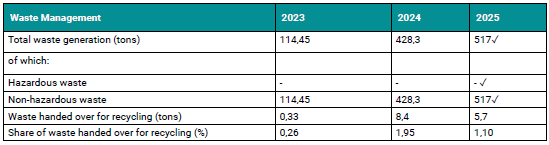
For facilities where waste disposal is handled by a third-party organization (cleaning services) and included in the contract cost, as well as for leased facilities where waste disposal is included in the lease payment, waste generation volumes are determined based on estimated values derived from available calculation and accounting data in the absence of primary data. The available calculation and accounting data include employee headcount by region and municipal waste generation and accumulation standards approved for the respective regions of the Republic of Kazakhstan.
The calculation is performed based on the employee headcount in each region, applying the current regional municipal waste generation and accumulation standards per employee. The waste volume is determined in cubic meters by multiplying the headcount by the corresponding regional standard and is then converted into tonnes using a conversion factor of 0.2 tonnes per 1 $m^3$ of waste. The final waste generation metric is formed by summing the calculated values across all regions of the Bank's presence. In 2025, the calculation covered 1,650 employees of the Bank, and the total volume of generated waste determined by the calculation method amounted to 2,585 $m^3$ or 517 tonnes. This metric is estimated and is based on regulatory values approved by local executive bodies and data on employee headcount by region.
The Bank provides additional actual waste data within the ESG Databook, which is available on the Bank's official website hcsbk.kz in the "Sustainable Development" / "ESG Reporting" section.