

- Home
- /
- Impact of climate risks on the Bank's portfolio
Impact of climate risks on the Bank's portfolio

Climate risk scenarios
JSC "Otbasy Bank" uses a scenario approach to assess the impact of climate risks on the mortgage portfolio, taking into account differences in the nature of risks:
• Acute physical risks (for example, floods and landslides) are considered as short-term, with an immediate impact on expected credit losses (ECL) within a horizon of up to 12 months.
• Transition risks associated with changes in regulation and technology are considered as long-term and are assessed based on NGFS scenarios:
− Orderly transition: gradual modernization of buildings over the next 5 years;
− Disorderly transition: protracted nature of adaptation with a horizon of 10–15 years.
Such an approach allows taking into account the specifics of various climate challenges and building reasonable assumptions when assessing the potential impact on the Bank's financial performance.
Impact of physical climate risks
A number of natural disasters caused by climate change, for example, an increase in air temperature, affect various natural processes - the speed and scale of glacier melting and the rise of groundwater levels, which in turn can lead to an increase in the intensity of mudflows, landslides and floods.
The risk of floods is significant in the spring months, when river levels and their flows rise due to snowmelt. A rapid and sharp increase in temperature can trigger rapid snowmelt and floods. Heavy rains combined with a rapid rise in temperature can exacerbate the scale of floods. In the spring of 2024, Kazakhstan once again faced such a large-scale natural disaster as floods. As a result of flooding, 10 regions were affected. In connection with the introduction of a state of emergency in the Republic of Kazakhstan and the floods, the Bank approved a procedure for granting a deferral of loan payments for a period of up to 90 (inclusive) calendar days. Applications for payment deferral were submitted for 89 loans from 6 regions affected by the floods, which constitutes 0.10% of the entire credit portfolio of these regions, while the share of the entire restructured portfolio of these regions constitutes 0.21%. As of January 1, 2026, there is one loan with overdue debt of more than 90 days among the loans that received payment deferrals due to the floods. This deferral was not a classical restructuring measure and was not classified as an indication of impairment.
For the Bank, within the framework of analysis and identification of areas with the greatest exposure to physical climate risks, the TOP-5 regions by level of losses were determined.
Based on the analysis of available climate data and the climate risk exposure map in Kazakhstan, the key physical climate threats relevant to the mortgage portfolio of JSC "Otbasy Bank" include the following:
• Risk of river and urban floods (inundations), relevant to almost all regions of the country, especially in the spring period due to intensive snowmelt and rising river levels;
• Risk of landslides and mudflows, characteristic of the southern and southeastern regions, where climate changes increase the probability of ground movements in mountainous and foothill areas;
• Water resources deficit, which is intensifying in a number of western and southern regions of the country and exerts an impact on infrastructure development and housing construction;
• Growth of extreme weather events, including heavy precipitation, sharp temperature fluctuations and dry periods, capable of affecting the physical condition of real estate objects acting as collateral for mortgage loans.
Of particular significance for the Bank are the flood risk and landslide risk, as it is they that exert the greatest impact on collateral, borrowers' solvency and the financial sustainability of the mortgage portfolio. At the same time, landslides, as a rule, are a concomitant and reinforcing factor during floods, which requires their comprehensive consideration in the risk assessment process.
The identification of these risks allows forming targeted adaptation measures and including climate factors into underwriting, monitoring, stress testing and strategic planning processes.
The results of the scenario analysis of the exposure of the credit portfolio of JSC "Otbasy Bank" to physical climate risks revealed the most vulnerable regions where potential losses on collateral could significantly increase under climate consequence conditions.
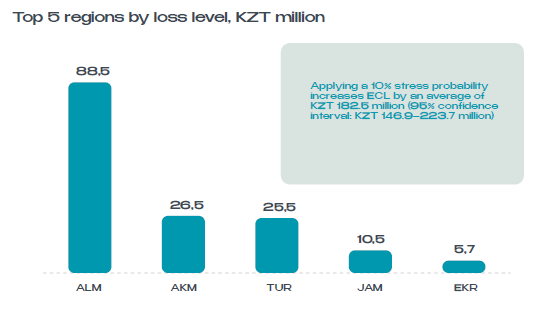
The balanced scenario (probability of floods and landslides of 10%) indicates a possible growth of expected credit losses within 146.9-223.7 million tenge (95% confidence interval), while the maximum increase in expected credit losses may constitute up to 2.25%. The largest losses are projected in the following regions:
• Almaty region – 88.5 million tenge,
• Akmola region – 26.5 million tenge,
• Turkistan region – 25.5 million tenge,
• Jambyl region – 10.5 million tenge,
• East Kazakhstan region – 5.7 million tenge.
Results of the balanced stress scenario (Probability of risk occurrence - 10%)
The high risk scenario (probability of floods and landslides of 100%) demonstrates potential losses of up to 877.1 million tenge in the Almaty region alone. Aggregate losses for the top-5 regions can reach more than 1,560 million tenge, and the maximum value of expected loss for the portfolio is 1,818 million tenge.
Results of the balanced stress scenario (Probability of risk occurrence 100%)
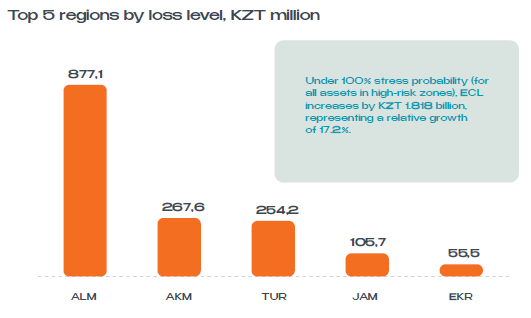
The greatest exposure to physical risks is demonstrated by Almaty city and Almaty region, which requires prioritization of adaptation measures, especially in the part concerning collateral, insurance parameters and underwriting in these regions.
Impact of transition climate risks
For JSC "Otbasy Bank", the key transition climate risks are the tightening of regulatory requirements in the field of energy efficiency and changes in market preferences towards sustainable housing. These factors could potentially exert a significant impact on the value of collateral and the structure of the Bank's mortgage portfolio.
The structure of the current portfolio by year of construction demonstrates high vulnerability to regulatory changes:
• About 21% (as of 01.01.2025 – 23%) of the current collateral portfolio is accounted for by objects built before 1991 – the least energy-efficient and potentially falling under the risk of impairment in the event of tightening of standards.
• Objects built before 2015 collectively constitute about 39% (as of 01.01.2025 – 40%) of the collateral portfolio, with most having an energy class of C and below.
• Only new objects built after 2015 fully comply with current energy efficiency standards.
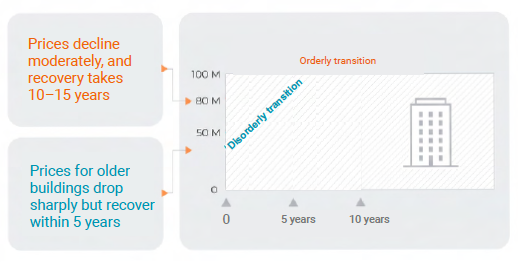
Approximate trajectory of the market value of collateral in various scenarios, million tenge
Potential financial consequences of transition risks were analyzed within the framework of scenario analysis. According to the results:
• In the balanced scenario, the loss estimate varies in the range of 68.5-73.9 million tenge (95% confidence interval), reflecting moderate consequences of the tightening of standards.
The forecast of the market value of objects shows that:
• In a sharp transition to new standards, the value of outdated buildings may significantly decrease and not recover within the next 5 years.
• In a moderate scenario, the decline will be smoothed, with recovery within 10–15 years.
At the strategic level, the Bank integrates climate aspects into the updated development strategy, including through setting decarbonization targets, developing ESG policies and including climate factors into the risk appetite framework. Simultaneously, a system of internal and external reporting on the climate agenda is being formed.
At the operational level, adaptation of investment and underwriting decisions taking into account climate criteria has begun, as well as employee training and implementation of a corporate culture focused on sustainable development, and implementation of mortgage products that meet the criteria of sustainable housing.
From the monitoring and management perspective, the Bank's key performance indicators (KPI) on climate aspects are implemented and tracked on an annual basis. In particular:
- calculations of direct and indirect emissions, including emissions from the loan portfolio for 2025, are presented in the section "Emissions of greenhouse gases and other pollutants into the atmosphere" of this report, as well as in the ESG Databook, published on the Bank's external website in the section "Sustainable Development"/ "ESG Reporting";
- the volume of sustainable financing and "green" loans is reflected in the sections "Monitoring of the Sustainability Strategy", "Implementation of social programs and projects", "Implementation of environmental projects" of this report, as well as in the ESG Databook, published on the Bank's external website in the section "Sustainable Development"/ "ESG Reporting";
- climate aspects are included in the management incentive system – achievements in the implementation and realization of climate and "green" initiatives are taken into account in the annual bonuses of the members of the Bank's Management Board.
The Bank conducts regular stress testing of climate risks in the mortgage portfolio. This approach ensures a systemic and progressive transformation of the Bank's business model in accordance with the international climate agenda.