

- Home
- /
- Training and Education
Training and Education
Recognizing that personnel development is a key cornerstone of any organization’s success, the Bank allocates budget funds annually for employee training and development. Educational programs at the Bank cover all employees, from senior management to specialists.
Information on the number of Bank employees who received training in 2025 is presented in the table below:
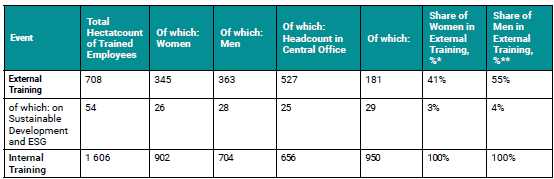
* The indicator is calculated as the ratio of the number of women who completed external training to the total actual headcount of female employees.
** The indicator is calculated as the ratio of the number of men who completed external training to the total actual headcount of male employees.
Employee Training Costs

During 2025, regular in-house training sessions were organized for Bank employees. These sessions focused on amendments and supplements to regulatory documents, raising employee awareness of sustainable development (ESG), and introducing the Bank's innovations aimed at upgrading its IT infrastructure and deploying a new information system. Training initiatives were also designed to enhance professional qualifications and boost the motivation of employees, enabling them to make effective decisions to accomplish the Bank's goals and objectives. Additionally, Bank employees attended external online seminars, courses, and training programs across various fields to develop professional skills and study global best practices. Employees regularly complete mandatory specialized courses to upgrade their professional qualifications and obtain certifications.
The Bank conducted 47 internal training events for the Headquarters and branch employees, against a planned target of 27 events for 2025. Internal training covers 100% of the Bank’s workforce. The topics of internal training were diverse, including: Internal Control System, Procurement of Goods, Works, and Services, Corporate Client Services, Raising Employee Information Security Awareness, Anti-Fraud Measures, The Bank’s Development Strategy, Consequences of Bank Secrecy Violations, Policy on Corporate Conflict Resolution and Conflict of Interest, Operational Risk and Business Continuity Management System, Anti-Money Laundering and Combating the Financing of Terrorism, Compliance Risk Management System, Anti-Corruption Measures, and others.
During the reporting period, the Bank launched a new distance learning platform — HR Portal — with the official transition taking place on July 31, 2025. As part of digitizing and automating employee training and development processes, and further expanding the HR Portal functionality, the following modules were implemented: "Catalog" (structured categorization of the course database), "Auto-assignment" of courses and training programs, "Events" and "Calendar", "Application System" for event participation, "Knowledge Base".
Throughout the reporting year, the library of electronic interactive courses in the HR Portal distance learning system was regularly updated and expanded for all Bank employees, which helped improve training accessibility and foster the professional competencies of the workforce.
As part of educational content development, the following training courses were designed and deployed:
1. Welcome to Otbasy Bank! (onboarding course for new hires)
2. Gender Equality.
At the same time, the Bank’s employees underwent external training aimed at upgrading their professional level and developing the competencies required to perform their duties effectively. As part of external training, the Bank’s employees attended courses and seminars dedicated to various professional topics, including sustainable development and ESG. 54 employees obtained professional certificates in sustainable development and ESG. During the reporting period, Bank employees participated in various conferences and events in the field of sustainable development and ESG, organized by various financial market professionals, including the regulator, in both online and offline formats.
Number of External Training Hours for Employees
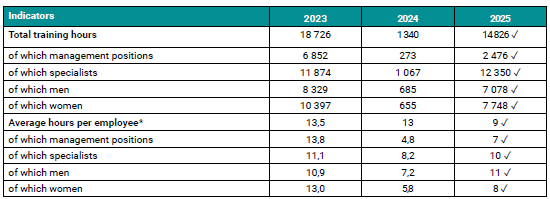
*The metric is calculated as the ratio of total external training hours conducted to the actual headcount.
*Average Number of Training Hours in 2025
*
*Number of External Training Hours for Employees on Sustainable Development and ESG
*
* The metric is calculated as the ratio of total external training hours conducted on sustainable development and ESG to the number of employees who underwent external training on sustainable development and ESG.
On a quarterly basis, the Bank assesses the performance of its Headquarters (Central Office) employees by setting Key Performance Indicators (KPIs) for all staff, with the subsequent review of their achievements for the reporting period by the Bank’s collegial bodies. In the reporting year, 100% of Headquarters employees underwent a quarterly performance review.
Under labor legislation, upon the termination of an employment contract by mutual agreement of the parties, a decision may be made to pay compensation of up to two monthly base salaries and/or a performance-based bonus for the reporting period for the time actually worked, based on the submitted report on the fulfillment of the KPI scorecard, and/or without reimbursement of training costs incurred. Furthermore, upon the termination of the employment contract, the employee may be provided with a letter of recommendation containing details about the employee's qualifications and their attitude toward work.
Talent Pool
The procedure for forming the talent pool for management and executive positions has been carried out at the Bank since 2008 in accordance with the Regulations on the Formation and Organization of the Bank's Talent Pool. This is achieved by identifying high-potential employees and organizing their professional and career growth. As of the end of 2025, the Bank's Talent Pool consists of 42 people, including 17 employees from the Central Office and 25 employees from the Bank's branches.
Employee Performance Appraisal
Since 2009, the Bank has conducted employee performance appraisals to determine the alignment of employees' qualifications with their job requirements, and to make necessary management decisions regarding further labor relations based on appraisal results. Appraisals are conducted no more than once every three years; however, in cases of unsatisfactory performance evaluation results (where KPIs fall below 75%), appraisals may be conducted up to once a year. The appraisal stages include an analysis of qualification requirements, testing, and a meeting of the Appraisal Committee. No appraisals were conducted in 2025.
Front-Office Employee Testing
Within the scope of internal training in 2025, employees underwent training across several areas. The topics of internal training were diverse, including: the Internal Control System, Procurement of Goods, Works, and Services, Corporate Client Services, Raising Employee Awareness of Information Security, Anti-Fraud Measures, the Bank's Development Strategy, Consequences of Non-Compliance with Banking Secrecy, the Policy on Settling Corporate Conflicts and Conflicts of Interest, the Operational Risk and Business Continuity Management System, Anti-Money Laundering and Counter-Terrorism Financing (AML/CFT), the Compliance Risk Management System, Anti-Corruption, and others.
Throughout the year, the library of electronic interactive learning courses within the "HR Portal" distance learning system, which targets all Bank employees, was regularly expanded and updated. The following e-courses were developed: 1) Customer Service Standards (Client Service); 2) Simulator: Technical Procedure for Registration, Authorization, and Termination of Agreements with a Consultant/Team Leader/Partner-Consultant in Information Systems; 3) Risk Management System for Money Laundering and Terrorism Financing; 4) Human Rights. Diversity and Inclusion.
On a monthly basis, information materials on anti-fraud measures were distributed to the Bank's employees.