

- Home
- /
- Performance under Strategic Objectives in 2025
Performance under Strategic Objectives in 2025
Implementation of State Programs
In the reporting year, acting as the operator of the Concept for the Development of Housing and Utilities Infrastructure for 2023-2029 (hereinafter – the Concept), the Bank provided loans to socially vulnerable segments of the population who are registered on the waiting lists of local executive bodies. Socially vulnerable segments of the population include, among others, persons with Group 1 and Group 2 disabilities, families having or raising children with disabilities, as well as large families and mothers, orphans or children left without parental care, and so on. As part of the Concept, the Bank issues preliminary housing loans at interest rates of 2% and 5% per annum, depending on the citizen's category.
All participants of the Concept acquire housing built by local executive bodies using loan funds.
In 2025, under state programs, 124 objects (8,519 apartments) with a total area of 723,645 sq. m totaling Tenge 92.8 billion were received for implementation.
As part of state programs (the Concept, state support measures), 5,277 loans totaling Tenge 67.8 billion were issued to Kazakhstanis in 2025, including 3,477 loans totaling Tenge 44.9 billion at a rate of 5% per annum and 1,800 loans totaling Tenge 22.9 billion at a rate of 2% per annum. Loans under the "5-10-20" direction were issued using revolving funds. Under the "2-10-20" direction, the issuance of loans was carried out using the remaining budget funds allocated in 2023, as well as revolving funds.
Best Customer Service
In accordance with the implementation of strategic objectives regarding the comprehensive transition of the Bank's activities, business processes, competencies, corporate culture, and business models into a digital Bank, making maximum use of the capabilities of digital technologies, the Bank is conducting work on developing and introducing innovative products using new technologies to form a new experience. Thus, since 2020, a video banking service has been operating at the Bank. The introduction of this functionality helped the Bank's customers apply for mortgages remotely and reduce visits to the Bank's branches to a minimum. Over 2025, 10,736 loan applications totaling Tenge 288 billion were processed. Video calls helped save time for the Bank's customers and obtain remote services for post-deposit operations. This function was utilized 543 thousand times. Furthermore, over 1.3 million customers received service through audio customer care over 2025.
In 2025, the deposit portfolio of internet banking reached the following indicators:
- the volume of savings amounted to more than Tenge 405.1 billion,
- the amount of inflows into deposits reached Tenge 268 billion,
- more than 278 thousand new contracts were opened,
- the activity of the deposit portfolio stood at 34.9%.
The following indicators were achieved for the Video Banking portfolio:
- the volume of savings amounted to Tenge 264.7 billion,
- the amount of inflows into deposits was more than Tenge 134 billion,
- the number of new contracts reached 72 thousand,
- the activity of the deposit portfolio stood at 35.6%.
With the aim of familiarizing customers with remote service via the Bank's online services, the number of digital guides in the Bank's branches was increased to 140 employees in 2025, which allowed for an increase in the share of remote service. The share of operations transferred to remote service channels in 2025 amounted to 48%.
The results of the joint project with JSC Kazpost to promote banking products in single-industry towns, small towns, district centers, and remote rural settlements of the Republic of Kazakhstan included an increase in the number of postmen who concluded a contract with the Bank; by the end of 2025, their number reached 251 people from 17 regions of the country. They took an active part in the project, effectively applying remote service channels to provide financial services to the population. As a result, 797 deposits were opened with the participation of postmen over 2024–2025.
Development of Products and Services
The Bank works on an ongoing basis to enhance and develop its products/services and pays special attention to the interests of all social groups of the population.
Today, the Bank offers its customers a number of social housing programs: state programs, regional programs with local akimats, youth programs, a program for military personnel, a women's program, a children's program, and others.
The Bank pays special attention to ensuring that the interests of all social groups are taken into account when developing the product line, and constantly works on the development and adaptation of its offering. ESG factors are integrated into the Bank's lending processes under special social programs.
Today, the Bank's product line includes a variety of in-demand products for every segment. In addition to state programs, the Bank successfully implements regional, youth, and corporate housing programs, a program for military personnel, as well as programs for women, children, and others.
The Bank has signed 183 agency agreements with local executive bodies for a total budget of more than Tenge 30 billion. Under the program, a total of 9,917 loans were issued for a total amount of Tenge 70 billion, as well as 17,513 resettlement allowances for a total amount of Tenge 26 billion.
In 2025, the Bank continued the implementation of the "Nauryz" program. The "Nauryz Zhumysker" program is a branch of the "Nauryz" program and is provided to representatives of working professions under the same conditions as "Nauryz".
The participants of this program are socially vulnerable segments of the population, working youth, young families, recipients of housing payments, bank depositors, and residents of single-industry towns, district centers, and rural settlements, including those on the waiting lists of local executive bodies (hereinafter – LEBs). As part of the implementation of this program, an architectural bond program was registered by the Bank. Taking into account the conditions and social focus of the "Nauryz" program, the Bank's bonds were assigned social status. The state subsidizes the coupon interest rates on the bonds. The programs provide for lending under the following conditions: 7% per annum for individuals registered as in need of housing under the category of socially vulnerable segments of the population; 9% per annum for other citizens of the Republic of Kazakhstan and Kandases. The down payment is: from 10% when purchasing primary housing with final finishes; from 20% when purchasing primary housing with rough finishes or on the secondary market. The maximum loan term is up to 19 years.
A new branch of the "Nauryz" program – "Nauryz Askery" – was also launched for recipients of housing payments. Within this branch, the down payment amount has been reduced to 0% of the loan amount. The loan amount is: up to Tenge 36 million for the cities of Astana and Almaty, and up to Tenge 30 million for other regions.
One of the Bank's most in-demand products is the military program. As a source of funding, the Bank raises funds on the market under market conditions and also uses its own funds. Today, the Bank is the only bank where special deposits have a special status and a guarantee of immunity.
In the IV quarter of 2025, the Bank resumed the issuance of preliminary housing loans under the "Askery Baspana" program (formerly "Zhana Baspana"/military product) for recipients of housing payments. The interest rate on the loan is 18% per annum with a down payment from 20%.
Since 2019, the Bank has been implementing the "Corporate" program, aimed at assisting enterprises in improving the housing conditions of their employees. The program is designed for organizations ready to allocate their own funds to provide workers with housing. This contributes not only to improving social conditions but also to retaining qualified specialists in the regions. The Bank annually invites large companies to cooperate under this initiative.
Since the beginning of 2023, the Bank has been implementing Kazakhstan's first "Green Mortgage" program for the purchase of apartments in energy-efficient residential complexes built according to "green standards," thereby supporting the strategic initiative to promote eco-friendly housing. The program is focused on protecting citizens' health and the environment.
The main condition for the implementation of the program is that the purchased housing must comply with the "green standard," certified under one of the existing systems in Kazakhstan (OMIR, GOST R, BREEAM, LEED), regardless of its certification level. This means that during the construction of houses, the developer uses environmentally friendly and safe materials, develops and landscapes the territory, all houses are thoughtfully placed, the air temperature can be regulated in the apartments, transport accessibility is available, etc.
To date, the Bank cooperates with 25 developers throughout Kazakhstan who comply with ecological construction standards, having concluded memorandums with them. The Bank plans to continue actively developing cooperation in this direction.
In 2025, the Bank allocated its own funds to the "Green Mortgage" program to maintain its active financing. During the year, the Bank successfully utilized Tenge 14.73 billion from its own funds. As a result, in 2025, under this program, the Bank provided mortgage loans to 570 customers totaling Tenge 14.73 billion. In total, since the launch of the green mortgage, 1,825 loans have been issued for an amount of Tenge 46.14 billion. The green mortgage portfolio as of January 1, 2026, amounted to Tenge 43.2 billion, and the share of green mortgages in the Bank's total loan portfolio was 1.07%.
IT Infrastructure Development and Automation of Business Processes
At the current stage, the financial sector of the Republic of Kazakhstan demonstrates a steady trend toward digital transformation and the introduction of advanced technological solutions. Digitalization in the modern world is one of the main factors of global economic growth. It has also not bypassed the banking system. The integration of digital technologies fundamentally transforms the Bank's operational efficiency and expands its product and service offerings.
The speed of innovation adoption in the banking sector is growing. The banking industry is one of the prominent examples of rapid digital development. A digital bank must develop at the speed of the changes occurring around it, taking into account the laws and other regulatory legal acts of the Republic of Kazakhstan.
In accordance with the Information Technology Development Strategy of JSC Otbasy Bank for 2024–2026 (hereinafter – the IT Strategy), which defines the key priorities for the implementation of innovative technologies, the Bank carries out the development of digital channels and the creation of conditions for the development of the mortgage lending market.
The IT Strategy was developed to form an information technology and innovation development plan aimed at addressing the Strategic Goals of JSC Otbasy Bank.
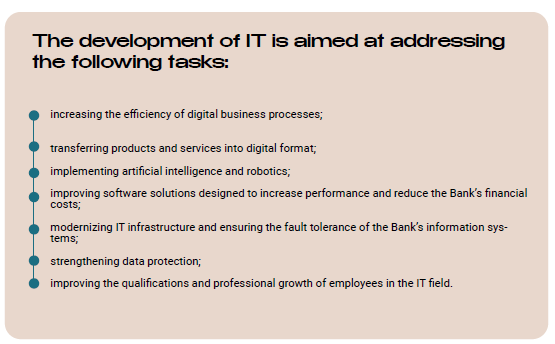
The main tasks of IT development are to meet basic needs in the digitalization of business processes, eliminate duplication of functions, and reduce operational costs, which the Bank has already partially achieved in the period from 2021 to 2024. Thus, the foundation was laid for the transition to the stage of innovative development of the digital component of the Bank's business.
The main tasks of the IT Strategy for 2024–2026 are defined as the further development of IT platforms based on microservice architecture, the digitalization of products and services, the widespread use of analytics tools across all channels to expand cross-selling and personalize customer offerings, the introduction of new services to form an omnichannel customer experience, and the creation of new and modernization of existing digital solutions.
As part of the IT Strategy objectives, the Bank intends to continue developing a number of innovative projects affecting virtually all business lines. In particular, this concerns the use of robotic process automation (RPA) technologies to optimize manual operations and accelerate the processing of customer operations and requests, expanding customer access to banking services and partners through open API technology, and introducing technologies that make it possible to offer customers goods and services using elements of gamification and principles of behavioral economics.
Rapid changes in technology, primarily in the field of the Internet, digital, mobile, and social platforms, drive significant shifts in customer preferences, behavioral models, and decision-making. The Bank's goal is to create a dynamic digital bank with an optimal structure of digital business processes, ensuring the implementation of advanced technologies for the development of banking services and innovative banking systems.
At present, there are two key directions for the integration of IT projects in the banking sector.
The first direction is the digitalization of customer service and increasing the efficiency of the Bank's internal and external communications.
The second direction is increasing the performance of the Bank's applications and information systems.
Within the framework of the IT Strategy, the Bank will work in these directions, and will also continue to develop its IT infrastructure in accordance with business needs, striving to maintain the infrastructure at a modern technological level.
Balanced Risk Management
In the course of risk management, the Bank utilizes various approaches, taking into account the requirements of the National Bank of the Republic of Kazakhstan as a participant in the state's financial system, such as:
- the three lines of defense system;
- formulation of the Bank's risk appetite strategy and risk appetite statements;
- capital adequacy assessment;
- liquidity adequacy assessment;
- conducting stress testing using sensitivity analysis and scenario analysis methods;
- ensuring the availability of a management reporting system for the timely communication of risk indicator data to the authorized bodies of the Bank.
To assess and determine the level of risks, the Bank also uses metrics for calculating risk levels based on group-wide approaches defined by JSC "NIH "Baiterek", such as risk-weighted assets (RWA), a probabilistic-statistical approach that measures the risks of potential losses taking into account the probability of their occurrence (VaR), and building a cash flow GAP analysis to assess liquidity risk and interest rate risk.
These models assist in the strategic planning of risk levels, as well as the strategic control and monitoring of decisions made in the area of risk management.
To successfully implement the strategy, the Bank on a regular basis analyzes key risks that could affect the achievement of strategic goals and the Bank's financial sustainability, and develops appropriate measures to mitigate them.
Effective Personnel Management System
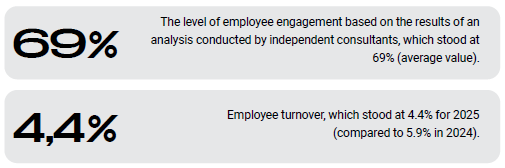
The Bank's primary competitive advantage is the ability to select talent, develop them professionally, hire the best employees, and manage them effectively in an accessible, inclusive environment. Thus, in 2025, the Bank conducted a series of initiatives aimed at developing, maintaining, and strengthening the Bank's HR brand in the market, increasing the level of knowledge and experience of the Bank's employees, and automating business processes in terms of personnel administration, among others.
Indicators of the efficiency of the Bank's personnel management system include:
The financial sustainability of the Bank is carried out through financial management aimed at achieving the strategic goals of the Bank. Due to the successful implementation of state programs, as well as programs funded by the Bank's own funds, an annual growth in revenue and net profit of the Bank has been observed over the past 5 years. The Bank's revenue amounted to Tenge 449,869 million (Tenge 80,692 million more than in 2024). The Bank's net profit for 2025 amounted to Tenge 126,434 million, which is Tenge 6,359 million above the plan (or 105%). The weighted average yield on temporarily free cash funds in the reporting period stood at 15.88%.
Implementation of ESG Principles
In 2025, the Bank upgraded its ESG rating assigned by the international rating agency Sustainable Fitch from 55 to 60 points while maintaining a score of "3". The increase in the assessment reflects the Bank's systematic approach to sustainable development, transparency in ESG disclosure, and the social impact of the business, including the publication of greenhouse gas emissions data under Scopes 1-3 and the expansion of indicators on gender equality and labor remuneration.
In the reporting year, the Bank approved the Sustainable Development Strategy, establishing a systematic approach to managing environmental and social risks, developing green financing, and increasing the transparency of corporate governance. The document is integrated into the Bank's overall development strategy and defines key ESG benchmarks until 2030.