

- Home
- /
- Water Consumption
Water Consumption
In its operations, the Bank seeks to reduce water consumption volumes, enhance the efficiency of water resource utilization, and minimize its impact on natural water bodies. The Bank unconditionally acknowledges the importance of careful and rational stewardship of the country's water resources.
The Bank's water consumption is detailed in the table below:
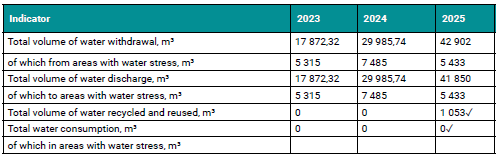
Water management metrics are calculated based on primary water consumption and discharge tracking records across the Bank's facilities, including the branch network and the Headquarters building. Water supply to the Bank's facilities is provided through centralized water supply systems, and wastewater discharge is managed via centralized sewage systems.
The metrics include the total volume of water withdrawn from municipal water supply systems (water withdrawal) and the volume of wastewater discharged into municipal sewerage systems. For owned facilities and leased premises with available supporting documentation, the calculation is based on actual water consumption data. For leased facilities where water supply and wastewater discharge are included in the lease payment and primary data is unavailable, estimated values calculated based on available accounting and billing data are applied.
Based on the facilities with available actual data on water consumption and discharge, water consumption and water discharge intensity ratios per unit of area are calculated as the ratio of the volume of consumed water and wastewater to the floor area of the premises. The resulting ratios are applied to estimate water consumption and discharge for facilities located in the respective regions that lack primary data, in proportion to the floor area of the premises.
For regions where actual data is completely unavailable, the average water consumption and discharge rate per employee is determined based on data from the regions with available metrics. The estimation is carried out by multiplying the resulting averages by the headcount in the respective regions.
Thus, the calculation of water use metrics is performed using a combination of actual data and calculation assumptions. The indicator is partially estimated and is based on available data on water consumption, facility area, and employee headcount.The "water consumption" metric is calculated as the difference between the volume of water withdrawal and the volume of water discharge. Given the nature of the Bank's activities (which are predominantly office-based), the vast majority of the water used is returned to the drainage system, making the actual water consumption negligible.
In 2025, the increase in water withdrawal was driven by the acquisition of the Headquarters building in Astana, as well as the presence of tenants within it that have higher levels of water use (such as a fitness center, a swimming pool, etc.). At the same time, the increase in water withdrawal was accompanied by a comparable increase in water discharge and did not significantly impact the overall water consumption metric.