

- Home
- /
- The Bank's Indirect Economic Impact
The Bank's Indirect Economic Impact
Improving housing affordability for the population is one of the key areas of the Bank's activities. The provision of mortgage loans for the purchase of housing contributes to the formation of effective demand in the residential real estate market and has a significant indirect economic impact on the development of housing construction, related industries, as well as on the socio-economic development of the regions of the Republic of Kazakhstan.
The key significant indirect economic impacts of the Bank include:
- development of housing construction and related industries;
- support for employment in the construction industry and related sectors of the economy;
- development of small and medium-sized enterprises involved in the construction, renovation, and improvement of housing;
- promotion of the socio-economic development of the regions;
- formation of long-term savings of the population and improving housing affordability.
The provision of mortgage lending forms the basis of the Bank's indirect economic impact. The growth in demand for residential real estate stimulates the implementation of new construction projects and an increase in the volume of housing construction. In turn, the growth of construction activity generates additional demand for building materials, equipment, and related services, exerting a positive impact on the development of the construction industry and related sectors of the economy.
Impact on Housing Construction and Related Industries
The financing of housing purchases helps maintain demand for residential real estate objects and the implementation of new construction projects. The growth in construction volumes creates additional demand for the products of manufacturers of building materials, enterprises in the metallurgical, electrical, and petrochemical industries, as well as for the services of contracting and design organizations.
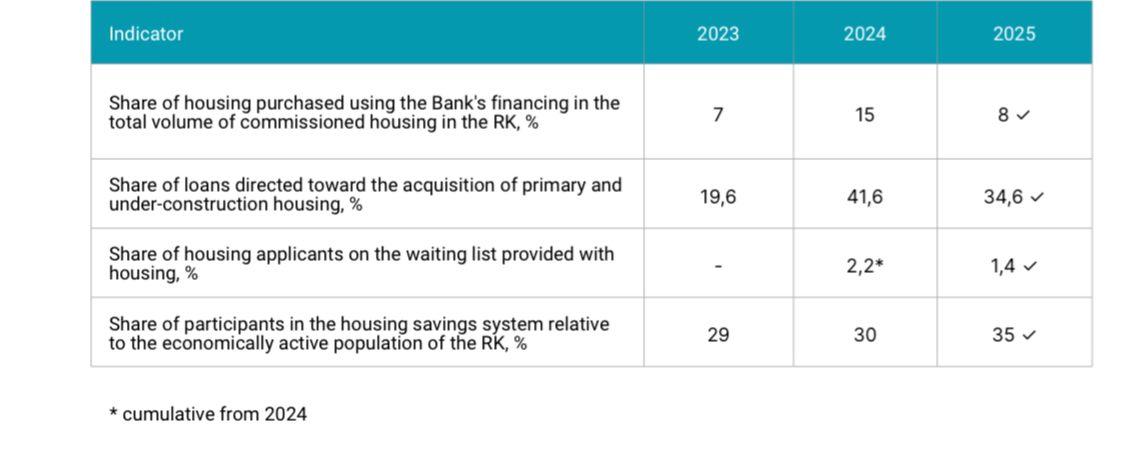
The scale of this impact is reflected in the volume of housing purchased using the Bank's financing. In 2025, 19 939 866 sq. m of housing (apartment buildings and individual residential houses) was commissioned in the Republic of Kazakhstan, while 1 574 340 sq. m[1], or 8% of the total volume of commissioned housing, was purchased using the Bank's financing. This indicator characterizes the significance of the Bank in ensuring demand in the residential real estate market and supporting housing construction.
Impact on Employment
The increase in housing construction volumes contributes to the retention and creation of jobs both directly in the construction industry and in related sectors of the economy associated with the production of building materials, logistics, engineering services, trade, and housing maintenance. The scale of this impact is driven by the significant role of the Bank in the housing finance market, within which 1 574 340 sq. m of housing, or 8% of the total volume of commissioned housing in the Republic of Kazakhstan, was purchased using the Bank's financing in 2025.
Impact on the Development of Small and Medium-Sized Businesses
The Bank's indirect economic impact is also manifested through the stimulation of economic activity in housing construction and its related sectors of the economy. The financing of purchases of primary and under-construction housing contributes to the formation of demand for new construction objects, which creates additional opportunities for construction companies, contracting organizations, suppliers of building materials, and other participants in the value chain in the housing sector. In 2025, 34.6% of the total volume of loans issued by the Bank (569 631 million tenge out of 1 645 151 million tenge) was directed toward the acquisition of primary and under-construction housing, which characterizes the scale of the Bank's impact on the new housing market.
Impact on the Socio-Economic Development of Regions
Improving housing affordability contributes to the improvement of housing conditions of the population and the development of regions. The implementation of housing projects stimulates investment activity, the development of urban infrastructure, and the formation of a comfortable living environment.
The scale of this impact is also characterized by the coverage of the population with housing savings tools and the support of citizens in need of better housing conditions. As of the end of 2025, the share of participants in the housing savings system relative to the economically active population of the Republic of Kazakhstan reached 35% (3 462 827 system participants out of an economically active population of 9 769 536 people). In addition, the share of housing applicants on the waiting list who have a priority right to receive housing and were provided with housing through the Bank under preferential programs (cumulative from 2025) amounted to 1.4% (4 289 people out of 309 491 priority housing applicants).
The key indicators characterizing the scale of the Bank's indirect economic impact are presented in the table below:
* cumulative from 2024
Taken together, these indicators reflect the scale of the Bank's operations in the housing finance market and characterize the indirect economic effects arising from increasing housing affordability for the population, supporting the construction industry, developing related sectors of the economy, and promoting the socio-economic development of the regions of the Republic of Kazakhstan.