

- Home
- /
- Greenhouse Gas and Other Pollutant Emissions
Greenhouse Gas and Other Pollutant Emissions
The Bank is committed to the national goal of the Republic of Kazakhstan to become carbon-neutral by 2060 and contributes to global efforts to mitigate and adapt to the consequences of climate change. The management of greenhouse gas (hereinafter – GHG) emissions is part of the Bank's environmental and climate responsibility system and covers operational activities as well as financed emissions.
The Bank strives to reduce the impact of GHG emissions generation from stationary and mobile installations, as well as from purchased energy used in the Bank's operational processes, on global climate change. The first step towards reducing the impact is the quantitative evaluation of GHG emissions from these processes based on international standards, including the Greenhouse Gas Protocol (GHG Protocol).
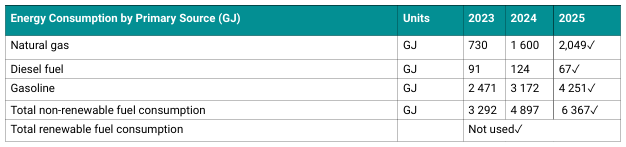
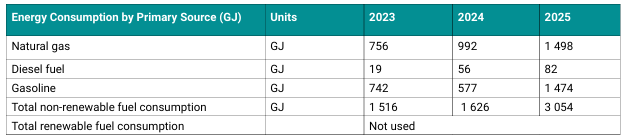
The table below presents the Bank's energy resource consumption by primary sources:
Energy Consumption Within the Organization:
Energy Consumption Outside of the Organization:
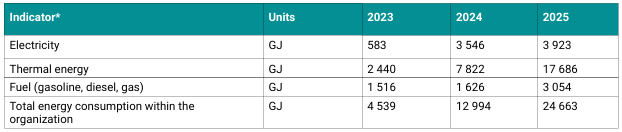
For a comprehensive assessment of the Bank's energy balance, total energy consumption within the organization is presented in the following tables:
Energy Consumption Within the Organization:
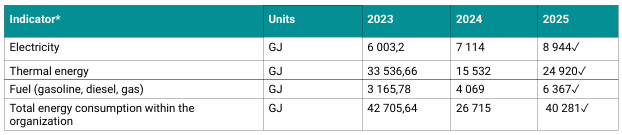
* The conversion of electricity and thermal energy consumption metrics into energy units (GJ) was performed in accordance with generally accepted physical conversion factors: 1 kWh = 0.0036 GJ and 1 Gcal = 4.184 GJ.
Energy Consumption Outside of the Organization
The table below outlines the key indicators of environmental and climate impact:
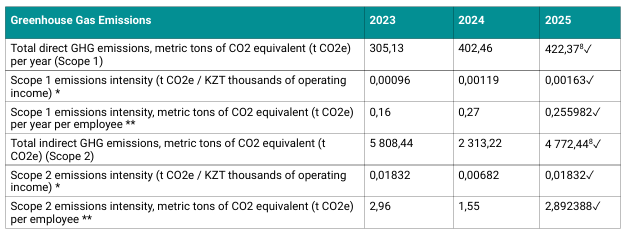
* The metric is calculated as the ratio of total annual Scope 1 emissions in CO₂ equivalent to the Bank’s total annual operating income expressed in KZT million (including interest, fee and commission, and other income).
** The metric is calculated as the ratio of total annual Scope 1 emissions in CO₂ equivalent to the actual headcount of the Bank for the respective reporting period.
8 The total Scope 1 and Scope 2 greenhouse gas emissions presented in this Report differ from the corresponding indicators disclosed in the Holding’s 2025 Sustainability Report due to the use of estimated values for certain facilities where primary supporting documentation was unavailable. The estimates were calculated based on the assumptions adopted under the applicable calculation methodology and were subject to independent assurance by PwC.
Calculations were conducted in accordance with the Bank’s Greenhouse Gas Emissions Calculation Methodology, available on the Bank's website under the "Sustainable Development" / "ESG Policies" section. The operational control approach is applied to define organizational boundaries. The calculation utilizes national emission factors of the Republic of Kazakhstan and a location-based approach for Scope 2. In cases where primary data for leased properties is unavailable, estimated energy consumption indicators are used. The calculation covers carbon dioxide (CO2), methane (CH4), and nitrous oxide (N2O), converted into CO2 equivalent in line with the Intergovernmental Panel on Climate Change (IPCC, 2006) Guidelines for National Greenhouse Gas Inventories. The emission factor sources include the List of Benchmarks for Regulated Sectors of the Economy of the Republic of Kazakhstan and the IPCC Guidelines, with global warming potential (GWP) values applied in accordance with IPCC assessment reports. Historical data has been recalculated using a unified methodological framework.
Quantitative assessments of greenhouse gas emissions are subject to inherent uncertainty due to limitations in the scientific knowledge used to determine emission factors and the values required to aggregate emissions of various gases.
The 5% increase in direct Scope 1 greenhouse gas emissions in 2025 compared to 2024 was driven by growth in fuel consumption by the Bank's own stationary and mobile emission sources.
The 106% increase in indirect Scope 2 greenhouse gas emissions was driven by the expansion of the Bank’s operational infrastructure, including the acquisition of the Headquarters building in Astana during the reporting year, which resulted in higher consumption of electrical and thermal energy.
To assess other indirect emissions under Scope 3, the following categories were identified as most significant for the Bank based on a materiality analysis in accordance with the GHG Protocol:
1) Category 1: Purchased goods and services (office paper);
2) Category 5: Waste generated in operations;
3) Category 6: Business travel;
4) Category 7: Employee commuting;
5) Category 8: Upstream leased assets;
6) Category 15: Investments (financed emissions - mortgages).
The selection of categories is based on an assessment of their materiality to the Bank, where financed emissions form the largest contribution.
Other categories of Scope 3 indirect emissions were evaluated according to the GHG Protocol and the IPCC Guidelines for National Greenhouse Gas Inventories (2006). Financed emissions under Category 15 are based on the requirements of the Global GHG Accounting and Reporting Standard for the Financial Industry (PCAF).
In the reporting year, the calculation of financed emissions was performed for the Bank's collateral/mortgage portfolio, reflecting its specific role as a national development institution in the field of housing finance. The calculation includes emissions associated with residential real estate properties pledged as collateral for outstanding loans. This approach reflects the Bank’s core business profile and allows for the assessment of the climate impact of the most significant portion of its loan portfolio. Other asset classes, including investments in bonds and other financial instruments, were excluded from the current scope of the calculation. The Bank plans to gradually expand the coverage of its financed emissions calculations to additional asset classes as the methodology evolves and the availability of the required data improves.
The calculation for the Bank's collateral portfolio is based on an estimation approach and is conducted using proxy indicators, including the floor area of the collateral real estate and regulatory energy consumption standards established by the building codes of the Republic of Kazakhstan. The use of an estimation approach and proxy indicators implies the use of lower-quality data in accordance with the PCAF methodology.
The consumption of thermal and electrical energy is determined using a calculation method, after which the corresponding emission volumes are calculated by applying emission factors.
Financed emissions are calculated taking into account the Bank's share in financing (the attribution factor). The attribution factor is defined as the ratio of the outstanding loan balance to the value of the collateral property.
In cases where the calculated attribution factor exceeds 1, it is capped at 1. This limitation is applied to reflect the assumption that the Bank's financing share in the asset does not exceed 100%, as well as to minimize potential distortions arising from discrepancies between the loan balance and the appraised value of the real estate.
Financed emissions are calculated considering the Bank's financing share (the attribution factor). For objects within the "green mortgage" framework, an adjustment reflecting a higher level of energy efficiency is applied.
The calculation of GHG emissions for Scope 3 Categories 1, 5, 6, 7, and 8 is carried out based on procurement, business activity, employee travel, and energy consumption data in leased assets using calculation formulas from the Bank’s internal methodology and appropriate emission factors. Financed emissions under Category 15 are calculated based on collateralized real estate data using an allocation model determined by the Bank's financing share and the area of the collateralized real estate, applying energy consumption standards. For the green portfolio, an assumption of a 5% reduction in specific thermal energy consumption compared to regulatory values is applied, in accordance with the higher energy efficiency class of the buildings. The assessment is conducted within the boundaries of the Bank's operational control using analytical and accounting data. The calculation applies emission factors from the List of Benchmarks for Regulated Sectors of the Economy of the Republic of Kazakhstan and the IPCC guidelines (2006). Global Warming Potential (GWP) values are utilized based on IPCC assessment reports. Historical data has been recalculated using a unified methodological framework.
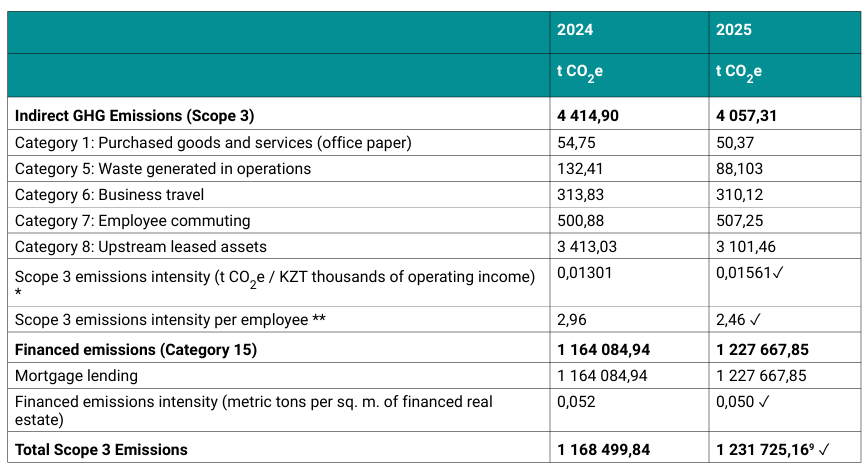
* The metric is calculated as the ratio of total annual Scope 1 emissions in CO₂ equivalent to the Bank’s total annual operating income expressed in KZT million (including interest, fee and commission, and other income).
** The metric is calculated as the ratio of total annual Scope 1 emissions in CO₂ equivalent to the actual headcount of the Bank for the respective reporting period.
In 2025, indirect greenhouse gas emissions (Scope 3) associated with the Bank's operational activities amounted to 4 057.31 tonnes of CO₂ equivalent, which is 8% lower than the 2024 figure (4 414.90 tonnes of CO₂ eq.). This decrease was primarily driven by a reduction in emissions under Category 5 "Waste generated in operations" and Category 8 "Upstream leased assets". For the remaining Scope 3 categories, no significant changes were observed, and the metrics remained at a level comparable to the previous reporting period. Scope 3 emissions intensity per employee decreased from 2.96 to 2.46 tonnes of CO₂ eq.
The primary contribution to total Scope 3 emissions comes from financed emissions associated with mortgage lending, which grew from 1 164084.94 to 1 227 667.85 metric tons of CO₂e due to the expansion of the mortgage loan portfolio. Despite the increase in the absolute figure, the intensity of financed emissions per square meter of financed real estate decreased from 0.052 to 0.050 metric tons of CO₂e. This reduction in financed emissions intensity from 0.052 to 0.050 metric tons of CO₂e per square meter of financed real estate is attributed to a 41% expansion of the green mortgage portfolio in 2025 and an increasing share of energy-efficient housing. As a result, total Scope 3 emissions increased from 1 168 499.84 metric tons of CO₂e in 2024 to 1 231 725.16 metric tons of CO₂e in 2025.
The Bank provides additional actual greenhouse gas emissions data within the ESG Databook, available on the Bank's official website hcsbk.kz under the "Sustainable Development" / "ESG Reporting" section.