

- Home
- /
- Message from the Chair of the Management Board
Message from the Chair of the Management Board
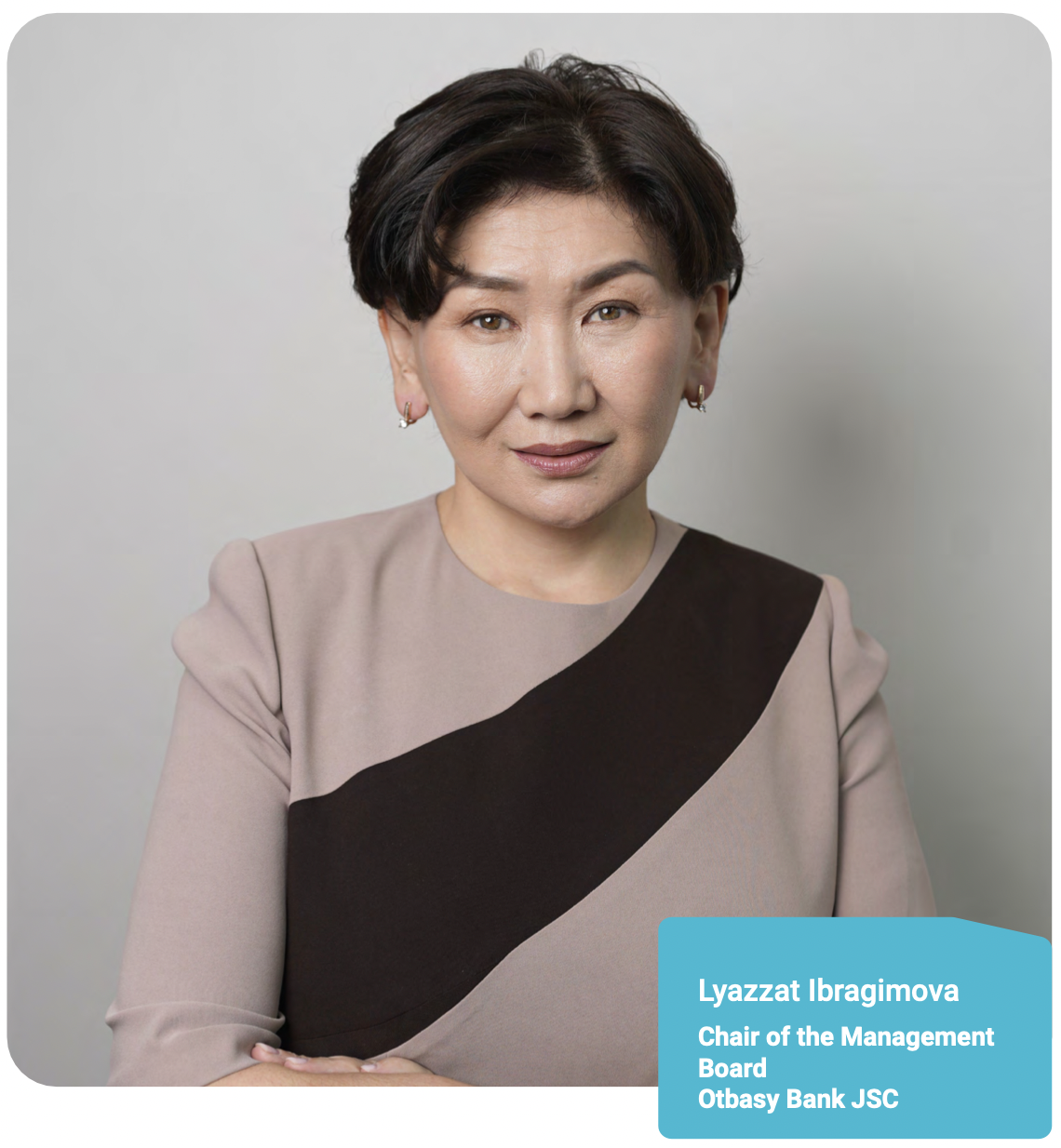
Dear Ladies and Gentlemen, Clients and Partners!
For Otbasy Bank, sustainable development is not a separate agenda but a fundamental operating principle. The decisions made by the Bank are aimed at improving the quality of life of our citizens and shaping a reliable foundation for future generations.
Otbasy Bank occupies a special place in the financial system of Kazakhstan. It is the only bank in the country that implements the housing construction savings system. Time has shown that this is an effective social policy tool that helps citizens purchase their own homes under affordable terms.
Today, every third working citizen is saving with Otbasy Bank while planning their family's future, and over this period, 650 437 people have celebrated moving into their new homes. In 2025, every third borrower of Otbasy Bank became the owner of the first home in their life. Behind these figures are happy families, children's laughter, and a sense of safety and confidence in tomorrow.
The Bank is already sharing its experience on international platforms, proving that socially oriented financial models can be sustainable, effective, and scalable.
In 2025, Otbasy Bank brought together international and regional experts in Almaty for the conference titled "Housing Construction Savings: Best Practices and Strategic Leadership across Various Regions." This event was organized with the support of the International Union for Housing Finance (IUHF) and the European Federation of Building Societies (EFBS).
In 2025, Otbasy Bank attained the status of a national development institution. This significantly expanded its role in implementing the state housing policy. As part of this transformation, key processes were digitized and automated, integration with state information systems was achieved, and the digital housing distribution platform orken.otbasybank.kz was launched. These solutions made the housing distribution system more transparent, understandable, and fair for citizens. Operating already under its new status, the Bank began the distribution of rental and credit housing in the regions. To support this, regional akimats (local executive bodies) transferred 9 261 apartments, of which 4 209 were allocated for credit housing and 5 052 for rental housing.
Alongside the social agenda, sustainable development is impossible without responsible corporate governance and partnership. In 2025, Otbasy Bank strengthened its cooperation with the Asian Development Bank (hereinafter referred to as the ADB). The Bank was visited by Leah Gutierrez, the ADB Director General for Central and West Asia. The discussions centered on sustainability approaches, long-term resilience, and joint work on projects that yield measurable benefits to society. Such cooperation confirms that the chosen development strategy complies with international standards.
A significant testament to the efficiency of Otbasy Bank's operations was the updated evaluation by the international rating agency Sustainable Fitch. The score was upgraded from 55 to 60 points, confirming the ESG rating at "3".
The score upgrade indicates that the Bank successfully continues to develop its social programs, transparently discloses its ESG initiatives, and effectively embeds sustainability principles into its operations.
For instance, in 2025, Otbasy Bank helped 381 families raising children with disabilities, 469 individuals with Group 1 and 2 disabilities, 729 large families, and 259 Kazakhstanis on the housing waitlist under the "orphans and children left without parental care" category to move into their new homes. The total amount of loans issued to them reached 24 billion KZT. In total, 1 842 preferential loans were issued to socially vulnerable segments of the population in 2025.
Sustainable Fitch highlighted the significant social impact of Otbasy Bank's activities, which occupy a pivotal place in the implementation of Kazakhstan's state housing policy.
This evaluation serves as a benchmark for the Bank's further progress. When speaking of sustainable development, it is vital to remember that we are addressing not only current results but also the future. Our projects are directly linked to the achievement of the UN Sustainable Development Goals – reducing inequality, developing sustainable cities, and enhancing the quality of life. Concurrently, the Bank works on reducing its own environmental impact, ensuring the rational use of resources, and raising environmental responsibility within the Bank.
In 2026, we will continue to help Kazakhstanis resolve their housing needs, develop social programs, and remain a reliable bank trusted by both our citizens and the state.